
Installation · 8 min read
How to Compare Window Quotations
Two quotations for the same project can differ by thousands and both be honest — because they are rarely quoting the same thing.
A smaller quotation is good value only when it buys the required specification and leaves no important project costs outside the figure.
Written by Windows in the Lakes · A trading name of Home Glazing Ltd
The cheapest window quotation is not always the cheapest completed project because quotations can differ in glass, frame system, hardware, thresholds, access, removal, installation, making good, certification and aftercare. Add every omitted but necessary item before comparing totals. A lower quotation can still be the better deal when the specification and scope are genuinely equivalent, exclusions are clear and the installer is comparably competent.
This is not an argument for choosing the highest price. It is an argument for comparing the same completed outcome.
| Figure | What it may include |
|---|---|
| Product price | Frames, glass and hardware, often excluding delivery and fitting |
| Installed price | Product and stated fitting scope, which may still exclude access or making good |
| Completed opening cost | Everything needed to leave the opening weather-tight and finished |
| Long-term project cost | Completed work plus foreseeable maintenance, adjustment or avoidable remedial work |
Do not assume the phrase ‘fully fitted’ resolves every boundary. Ask what happens to plaster, render, stone, cills, decoration, alarms, blinds and damaged substrate after the old frame is removed.
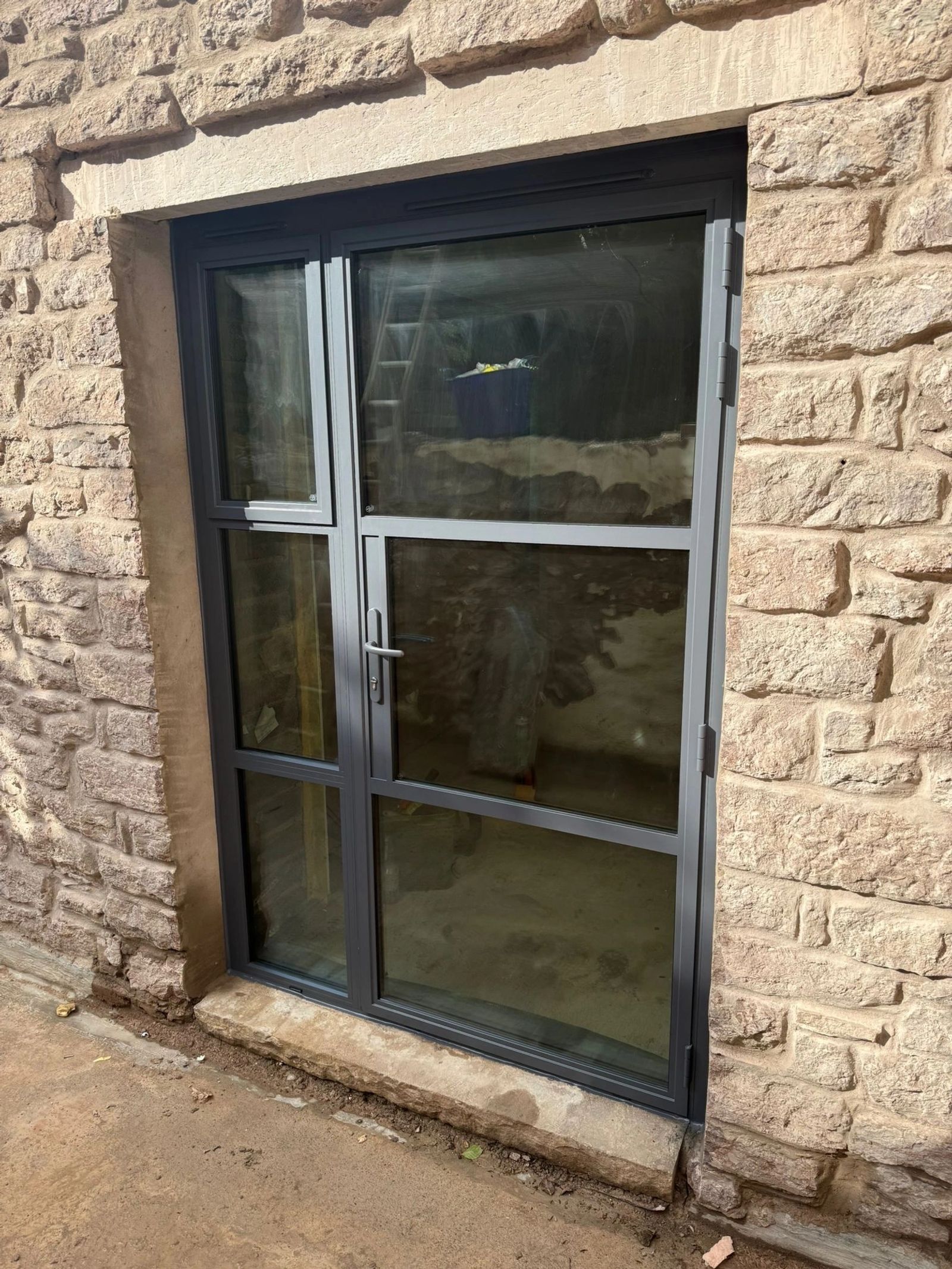
Two drawings can show the same openings while the quotations specify materially different projects. One may use a named thermally broken aluminium system and project-specific glass; another may use a different profile, standard glass, basic hardware or a threshold unsuited to the desired floor detail. Those differences are not automatically good or bad, but they must be visible.
| Often omitted | Where the eventual cost appears |
|---|---|
| Scaffolding or lifting | Access contractor, crane or specialist glazing equipment |
| Removal and disposal | Labour, skip or waste charge |
| Lintels and structural work | Builder or structural engineer |
| Plaster, render or pointing | Making-good trade after installation |
| Decoration | Painter after materials have cured |
| Building Control route | Application or inspection fee where self-certification does not apply |
| Delivery or storage | Additional logistics if programme or access changes |
An exclusion is not a defect if it is deliberate and priced elsewhere. It becomes expensive when no one has allowed for it or when two trades each assume the other is responsible.
Suppose one quotation excludes scaffolding, disposal and internal making good, while another includes all three. The first number is smaller, but the homeowner still needs those tasks completed. Once realistic allowances are added, the order may reverse. The same applies where a low threshold requires drainage work, large glass requires mechanical lifting, or a rough opening changes after technical survey.
Performance suitability also has a cost dimension. A product selected without regard to opening size, exposure or drainage may require redesign before order, or remedial work later. That does not mean the expensive system is always superior; it means suitability should be established before price is treated as final.
Choose the lower quotation with confidence when the named frame and glass specification are equivalent, the installation and finishing scope match, exclusions and provisional sums are equally clear, payment terms are acceptable, certification and written warranty routes are comparable, and the installer can show relevant competence.
A supplier should be able to explain a price difference without predicting failure or disparaging another company. Ask for the technical or scope reason. If the difference cannot be identified in the written specification, it should not carry much weight in the decision.
Compare the deposit, staged payments and balance trigger alongside the total. A low figure with a large early payment transfers more risk than the same figure with payments tied to clear milestones. Check what confirms the manufacturing slot, what happens if building work delays installation and whether storage or repeat delivery can become chargeable.
Programme has a project cost too. If late glazing delays plastering, finishes or occupation, the consequence may be larger than a modest difference between quotations. That is not a reason to accept an unrealistic promise. Ask for a realistic range, the point from which lead time runs and which customer decisions must be complete before the clock starts.
Water around a threshold, cracked finishes or a door that will not run correctly can involve product, installation, structure, levels or surrounding building work. A complete quotation and survey reduce ambiguity by recording the intended interfaces and responsibility boundaries. They do not eliminate every future issue, but they make diagnosis and resolution more direct.
Do not add an arbitrary future-repair allowance to every lower quotation. Instead, compare evidence that foreseeable risks have been considered: suitable system limits, final dimensions, drainage, access, installation method and a clear aftercare route.
Quotation A is lower and excludes access equipment, disposal and internal plaster repairs. Quotation B includes those items but specifies the same frame, glass and hardware. The fair comparison is not A against B as printed. Add genuine prices for the three missing scopes to A, then compare the adjusted totals, payment terms and delivery responsibilities.
If A remains lower and the installer, survey, certification route and warranty are comparable, A may be the better deal. If B becomes lower once the gaps are filled, its original headline was not expensive; it was more complete. The method protects both lower-priced and more comprehensive quotations from an unfair comparison.
Next step
We design, specify and install across Cumbria, the Lake District and the wider North. Send drawings, photographs or simply a description of the building and we will tell you what is possible and what it should cost.
Questions
If your question isn’t here, we would rather talk it through properly than guess.
Book a Design ConsultationVisit the Knowledge CentreKeep reading
Installation · 8 min read
Two quotations for the same project can differ by thousands and both be honest — because they are rarely quoting the same thing.
Buying Guides · 6 min read
A clear answer before signature is far easier and less expensive than an assumption discovered during installation.

Flagship guide · 9 min read
Two homes with the same number of windows can end up on very different invoices. Here is what genuinely moves the price, and what does not.
Installation · 6 min read
A good survey turns design intent and provisional dimensions into a coordinated, manufacturable installation plan.
Build your own collection of expert advice as you plan your project.
Wondering how this applies to your own home?
Share a photograph and we’ll turn this guidance into recommendations for your property.
Ready to understand the likely investment?
Start your personalised Project Investment Guide and see comparable completed projects.
Begin
Bring us your drawings, your site photographs or simply an idea. We will tell you what is possible, what it should cost and how long it will take.